


Internal Tooth Bleaching
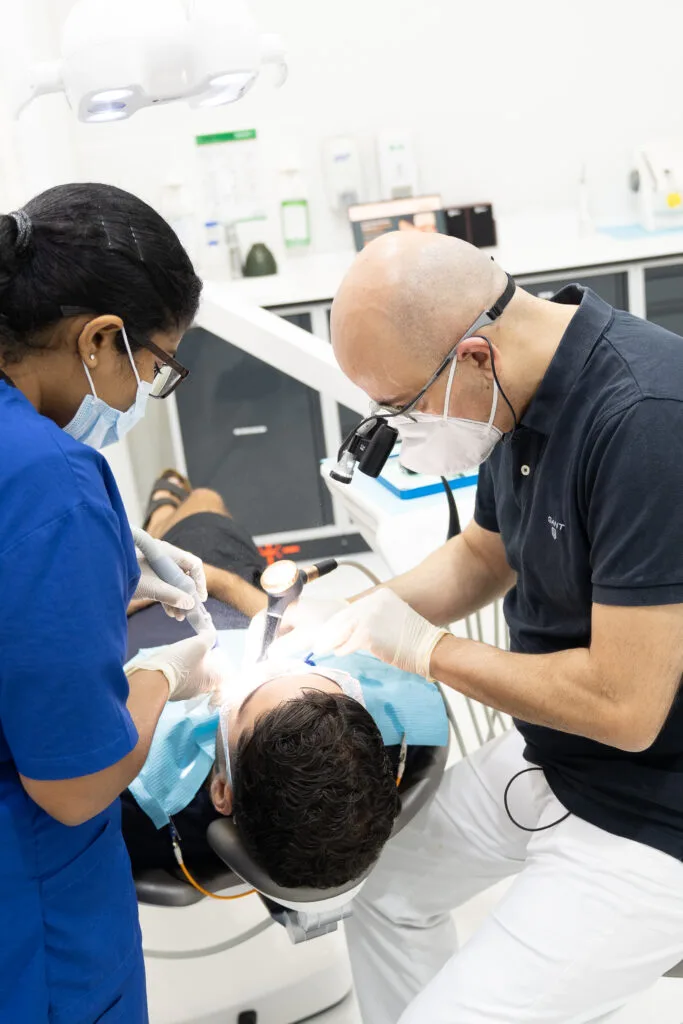
Internal tooth bleaching is a whitening procedure for selected discoloured teeth that have already received root canal treatment. Unlike external whitening, the material is placed inside the tooth to address colour changes originating within the tooth structure. At Bourgeois Dental Clinic in Dubai, treatment is recommended only after assessing the root canal filling, tooth structure, cracks, restorations, gum condition, and cause of discolouration.
What Is Internal Tooth Bleaching?
Internal bleaching, sometimes called non-vital bleaching, is used for a tooth that no longer has living pulp tissue and has been appropriately root treated.
The dentist creates controlled access to the internal part of the tooth, protects the root canal filling, places a whitening material inside the crown portion, and seals the tooth temporarily.
How Is Internal Bleaching Different from Regular Whitening?
External whitening products are applied to the outer surfaces of natural teeth and work through the enamel and dentine.
Internal bleaching places whitening material inside a root-treated tooth to address internal discolouration. External whitening alone may not adequately change the colour of a dark non-vital tooth.
Why Can a Root-Treated Tooth Become Dark?
Possible causes include:
- Dental trauma and internal bleeding
- Pulp death
- Breakdown products from blood or pulp tissue
- Previous root canal materials
- Old restorative materials
- Internal staining within the dentine
- Incomplete removal of pulp tissue from the crown portion
- Changes occurring over time after treatment
Who May Be Suitable for Internal Tooth Bleaching?
Potential candidates generally have:
- A root-treated tooth with internal discolouration
- A satisfactory root canal filling
- No active infection around the root
- Sufficient healthy tooth structure
- No significant untreated crack or fracture
- A restoration that can be safely accessed and resealed
- Realistic expectations about colour improvement
When May Internal Bleaching Not Be Suitable?
It may not be appropriate when there is:
- Untreated or inadequate root canal treatment
- Active infection or symptoms
- A leaking restoration
- Extensive decay
- A deep crack or root fracture
- Severe structural loss
- A large crown, veneer, or restoration that determines the visible colour
- Discolouration caused mainly by restorative material
- Insufficient tooth structure for a reliable seal
What Happens During the Consultation?
The dentist reviews the cause and duration of discolouration, previous trauma, root canal history, symptoms, restorations, and desired shade.
The assessment may include:
- Clinical examination: Checking tooth colour, cracks, decay, restorations, and gum condition.
- Dental imaging: Reviewing the root canal filling, root, surrounding bone, and possible infection.
- Restoration assessment: Determining whether fillings, veneers, or crowns affect the colour.
- Shade comparison: Comparing the tooth with neighbouring teeth.
- Structural assessment: Confirming that the tooth can be safely accessed and resealed.
- Option discussion: Comparing internal bleaching with bonding, veneer, crown replacement, or combined treatment.
How Is Internal Tooth Bleaching Performed?
The procedure commonly includes:
- Access to the tooth: The dentist removes part of the existing filling to reach the internal chamber.
- Root-filling review: The root canal seal and internal anatomy are assessed.
- Protective barrier: A barrier is placed over the root canal filling to separate it from the whitening material.
- Whitening material: A suitable material is placed inside the crown portion of the tooth.
- Temporary seal: The access is closed temporarily.
- Shade review: The tooth colour is reviewed after an appropriate interval.
- Repeat treatment: The material may be replaced during additional appointments when clinically appropriate.
- Final restoration: The whitening material is removed and the access is sealed with a permanent restoration.
How Many Appointments Are Required?
The number of visits depends on the original shade, cause of discolouration, tooth structure, response to treatment, and desired level of improvement.
Some teeth require several applications. Colour changes should be gradual and monitored rather than pursued without limit.
Will the Tooth Match the Neighbouring Teeth?
The aim is to improve the colour and achieve a closer match, but an exact result cannot be guaranteed.
The outcome depends on the type and depth of staining, enamel thickness, existing restorations, neighbouring tooth colour, and response to whitening.
Can the Tooth Become Too White?
Over-lightening can create an unnatural mismatch. Treatment should be reviewed between applications and stopped when an acceptable shade is achieved or further improvement becomes limited.
Can Internal Bleaching Change the Colour of Fillings, Veneers, or Crowns?
No. Whitening materials do not predictably change the colour of composite fillings, veneers, crowns, or other restorative materials.
Existing restorations may require replacement after whitening if they no longer match the tooth.
Can Internal Bleaching Be Combined with External Whitening?
Yes, selected patients may receive external whitening for the surrounding natural teeth and internal bleaching for the root-treated tooth.
The sequence and shade planning should be coordinated before replacing visible restorations.
Is Internal Tooth Bleaching Safe?
When clinically appropriate and performed with suitable protective measures, internal bleaching can be a conservative alternative to covering the entire tooth with a veneer or crown.
However, it has risks and limitations, and the tooth must be assessed before treatment.
What Are the Risks and Limitations?
- Incomplete colour improvement
- Colour relapse over time
- Mismatch with neighbouring teeth
- Need for repeated appointments
- Temporary leakage from the access restoration
- Damage to weakened tooth structure
- Need to replace existing restorations
- External cervical root resorption in rare cases
- Need for a veneer, crown, or bonding if whitening is insufficient
What Is External Cervical Root Resorption?
External cervical root resorption is a rare complication involving loss of root structure near the gumline. The risk has been associated with some internal-bleaching techniques, particularly when protective barriers or suitable materials are not used.
Careful case selection, root-filling assessment, barrier placement, and professional monitoring are important.
Can a Cracked Root-Treated Tooth Be Bleached?
A cracked tooth requires careful assessment before bleaching. A significant crack may allow leakage, weaken the tooth, or make a crown or another protective restoration more appropriate.
Internal bleaching does not repair structural damage.
Is Internal Bleaching Better Than a Veneer or Crown?
Internal bleaching may preserve more natural tooth structure when the main concern is colour and the tooth remains structurally suitable.
A veneer or crown may be more appropriate when the tooth also requires changes in shape, coverage, strength, or restoration of extensive damage.
No option is best for every patient.
How Long Does the Result Last?
Colour stability varies. Some teeth remain improved for a long period, while others gradually darken and may require reassessment or repeat treatment.
Trauma, internal materials, restoration leakage, ageing, and tooth structure can influence colour stability.
How to Care for the Tooth After Internal Bleaching
- Avoid biting hard objects with a structurally weakened tooth
- Complete the permanent access restoration
- Maintain daily brushing and interdental cleaning
- Attend recommended follow-up appointments
- Report pain, swelling, or renewed darkening
- Replace mismatched restorations only after the colour has stabilised
- Use a night guard when grinding is present and clinically relevant
Internal Tooth Bleaching on Sheikh Zayed Road
Bourgeois Dental Clinic is located on the first floor of Indigo Sky Building, Sheikh Zayed Road, Exit 41, near Al Thanya Street in Dubai. The clinic is accessible from Al Barsha, Umm Al Sheif, Umm Suqeim, Jumeirah, Al Quoz, Barsha Heights, The Greens, Dubai Marina, and surrounding communities.
Book an internal tooth-bleaching consultation to assess a dark or discoloured tooth that has previously received root canal treatment.
Department
Endodontics
FAQ
Frequently Asked Questions
BOOK AN
Appointment
Working Hours
We are here to serve you